

 +35 pts
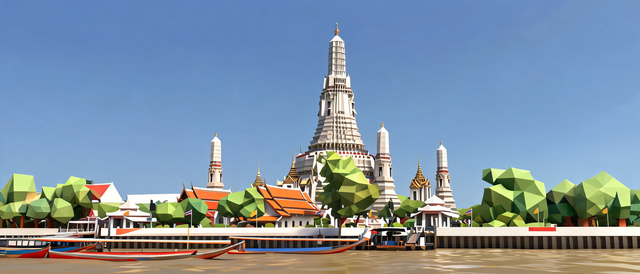
Fragments of Chinese porcelain and seashells cover Wat Arun’s central prang, forming floral patterns across its surface. Steep stairways climb between smaller prangs on the Chao Phraya’s west bank, while guardian figures stand among the temple’s tiled structures.
Photo check-in on siteWe verify the photo's location automatically
About Wat Arun
Wat Arun Ratchawararam Ratchawaramahawihan is a Buddhist temple whose site dates to the Ayutthaya Kingdom, before the reign of King Narai. It was first called Wat Bang Makok, then Wat Makok, and was renamed Wat Chaeng by Taksin after he made Thonburi his capital. The Emerald Buddha was kept here before being moved to Wat Phra Kaew in 1785. Rama II began plans to enlarge the main pagoda, and construction continued under Rama III until its completion in 1851.
The central prang represents Mount Meru in Hindu cosmology. Its four smaller prangs are linked with Phra Phai, the wind god, while the top carries a seven-pronged trident associated with Shiva. Figures of Chinese soldiers and animals surround the base, and statues of Indra riding Erawan appear above the second terrace. Beside the prang, the Ordination Hall contains a Niramitr Buddha image said to have been designed by Rama II. Its murals date from the reign of Rama V, and two guardian demons stand before the entrance.
Facts from Wikipedia: Wat Arun
More quests in Bangkok
All 26 in Bangkok- Red SkyA circular bar rises above the hotel roofParty · Bangkok · 5.4 km away
- Bamboo BarBamboo is woven through the whole roomParty · Bangkok · 3.5 km away
- Artist HousePuppets share an old house beside the canalArt · Bangkok · 3.1 km away
- Lumphini ParkWild lizards live in this city parkNature · Bangkok · 5.9 km away
More history quests
All History- TiscaliStone huts fill a hollow where the mountain brokeHistory · Dorgali
- Old MillfunConcrete once housed the city's largest slaughterhouseHistory · Shanghai
- Santa Cristina WellA Bronze Age temple lies below the groundHistory · Paulilatino
- Villa RufoloA garden here became an opera settingHistory · Ravello