

 +35 pts
Photo check-in on siteWe verify the photo's location automatically
About Hawa Mahal
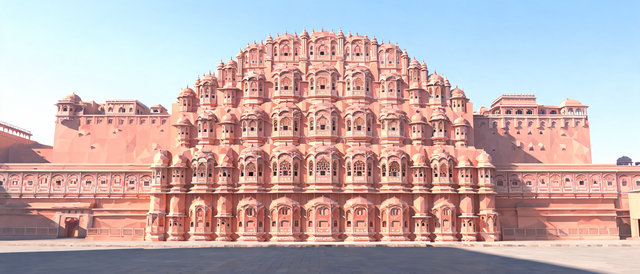
The Hawa Mahal is a palace on the edge of Jaipur’s City Palace, extending to the Zenana, or women’s chambers. Maharaja Sawai Pratap Singh commissioned it in 1799 after being inspired by Khetri Mahal. The architect was Lal Chand Ustad. Its name translates from Persian as “wind palace”, referring to the air moving through its openings. This airflow, including a Venturi effect, helped cool the palace in Jaipur’s hot summers.
The building has a five-storey pyramidal form, rising about 15 metres. Its upper three levels are each only one room wide, while the lower two have patios. The street-facing side is richly detailed with carved sandstone grills, arches, domes, finials and hanging cornices. This is actually the rear of the palace, while the inner side is more simply arranged with chambers, pillars and corridors. Entry from the City Palace leads to a courtyard with double-storey buildings and an archaeological museum. The palace combines Rajput features such as domed canopies and lotus patterns with Mughal arches and stone inlay work.
Facts from Wikipedia: Hawa Mahal
More quests in Jaipur
All 12 in Jaipur- Steamed MomosSteam keeps their folded dough softFood · Jaipur · 3.8 km away
- Central ParkA flag mast rises above the park’s tree lineNature · Jaipur · 2.8 km away
- GaitorRoyal memorials stand above a cremation groundHistory · Jaipur · 2.1 km away
- Sawai MansinghIndia and Pakistan met here for its first TestSport · Jaipur · 4.1 km away